


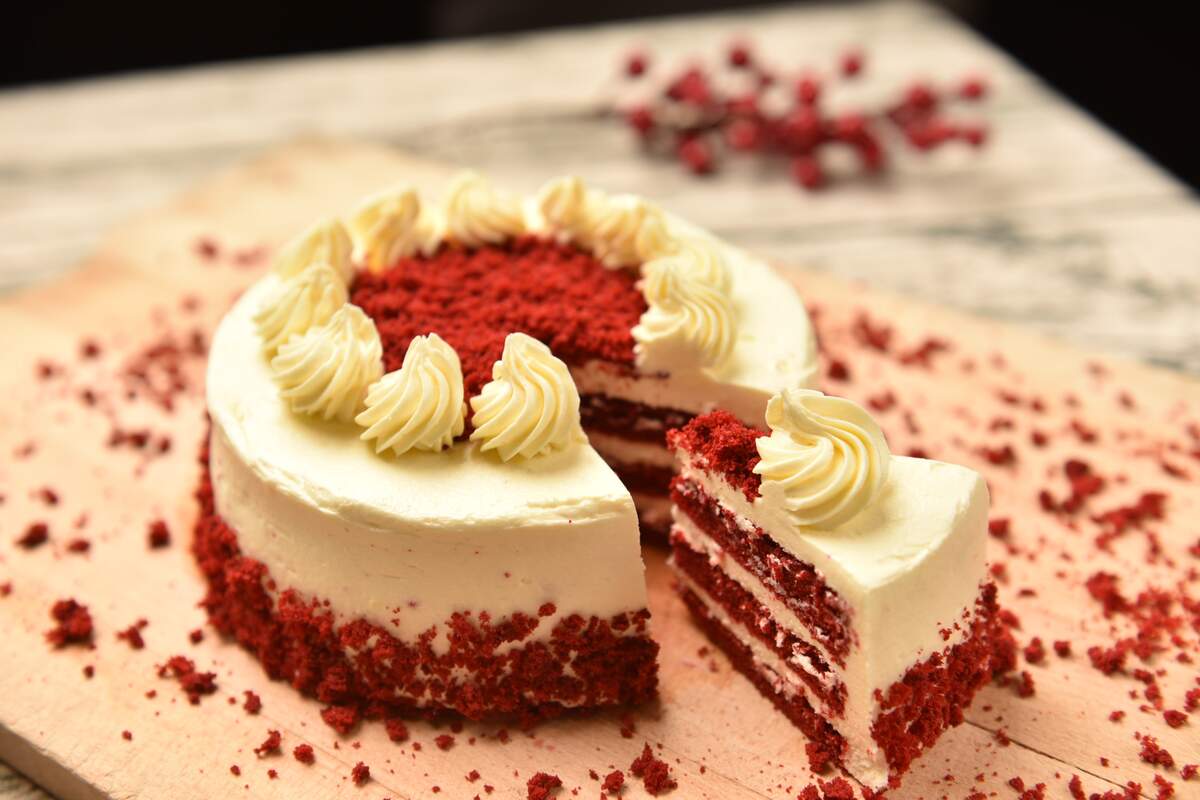
National Red Velvet Cake Day
Observed
annually on September 18th
Dates
September 18th, 2024
September 18th, 2025
September 18th, 2026
September 18th, 2027
September 18th, 2028
Tags
Food & Drink
Snacks & Desserts
Hashtags
Sources
https://blog.thenibble.com/2021/09/18/red-velvet-cake-recipes-for-national-red-velvet-cake-day/
https://en.wikipedia.org/wiki/Red_velvet_cake
https://www.foodnetwork.com/how-to/packages/food-network-essentials/what-is-red-velvet-cake
https://www.southernliving.com/food/desserts/cakes/southern-red-velvet-cake
Red velvet cake is celebrated and enjoyed today with National Red Velvet Cake Day! Red velvet cake is made with vanilla, cocoa powder, and red food coloring. It also contains buttermilk and vinegar, which makes it tangy, but this is balanced out with its sweet frosting, made with cream cheese and butter. The crumb of the cake is smooth, fine, and soft. Red velvet cake is particularly popular in the South and is considered part of Southern culture, though it was not created there.
The term "velvet cake" was first used during the Victorian era, to characterize a fluffy, soft cake with fine crumbs, differentiating it from the popular sponge cakes and pound cakes of the time, which were denser and chewier. Cooks discovered they could combine acidic ingredients like vinegar—which was used as a cake tenderizer—with the most widely available chocolate of the time, non-Dutch-processed cocoa, to give cake a faintly red color. Mahogany cake had this reddish hue. Devil's food cake was common at the time, but it used chocolate, not cocoa, which gave it a deep brown color. A recipe published in 1911 combined these two cakes to make velvet cocoa cake.
This recipe spread throughout the next few decades. Buttermilk, a common ingredient in the South, was added, making the cake tangier and more acidic, and thus even redder. The Waldorf-Astoria in New York City started serving red velvet cake in the 1930s. It became popular there, and helped raise the cake's profile beyond its doors. The hotel is sometimes credited with creating red velvet cake, but it did not. Around the same time, Eaton's department store in Toronto also began selling a red velvet cake that gained attention beyond its doors.
Early red velvet cake frosting was a French roux-style buttercream, but cream cheese frosting largely supplanted it, although a similar ermine frosting is sometimes used. In the years leading up to World War II, the cakes were made redder by adding beet juice. But the bright red color associated with red velvet cakes today came from artificial red food coloring, which also became more widely available in the years before World War II.
John A. Adams of Texas had a company, Adams Extract, that sold food-grade extracts and dyes. Adams and his wife Betty had eaten red velvet cake at the Waldorf-Astoria, and it gave them the idea to create a similar recipe but using their red food dye to color it. They also added vanilla extract and butter flavoring. (Real butter was rationed at the time because it was during World War II.) The recipe from Adams Extract became known across the country. Although red velvet cake did not yet reach the national popularity it has today, by the 1960s many were familiar with it, and many cookbooks and newspapers were printing recipes for it. However, its popularity declined in the 1970s when Red Dye #2 was linked to cancer.
The armadillo-shaped red velvet cake in the 1989 film Steel Magnolias helped the cake regain popularity and strengthened its association with the South. Magnolia Bakery opened in New York City in 1996, where red velvet cakes became bestsellers. By the early 2000s, red velvet cakes were widely available and hugely popular in bakeries across the United States, more so than they'd ever been before, and this continued into the 2010s and beyond. There are now many takes on the classic red velvet cake, such as red velvet cupcakes, cheesecake, doughnuts, cookies, and ice cream. Today, on National Red Velvet Cake Day, we celebrate and enjoy red velvet cake in all its forms!
How to Observe National Red Velvet Cake Day
- Make red velvet cake to celebrate with. Make a classic one or try your hand at the Adams Extract recipe or Waldorf-Astoria recipe.
- Pick up a red velvet cake from a local bakery.
- Pick up a red velvet cake from Magnolia Bakery, a bakery known for its red velvet cakes and helping to repopularize them towards the end of the twentieth century.
- Order a red velvet cake online from a company like Daisy Cakes.
- Try your hand at making other red velvet desserts.
- Pick up a red velvet cake cookbook such as The Red Velvet Lover's Cookbook.
Exclusive Content
Enjoying Checkiday? It takes a lot of support from fans like you to run a free website. For exclusive content and other perks, please consider supporting us on Patreon. Thank you!Sponsor
This event does not currently have a sponsor. If you'd like to increase visibility for this event while gaining exposure for yourself or your brand, you can learn more here.Something Wrong or Missing?
We would love to hear from you! Please contact us using this form.Observation Notifications
Would you like to be notified before the next observation? Add this event directly to your calendar with this link. You may also sign up here to be told when other notifications are available!Also on this date…



Don't miss a beat! Subscribe to any of the following feeds for daily updates.
turned_in














 notifications